
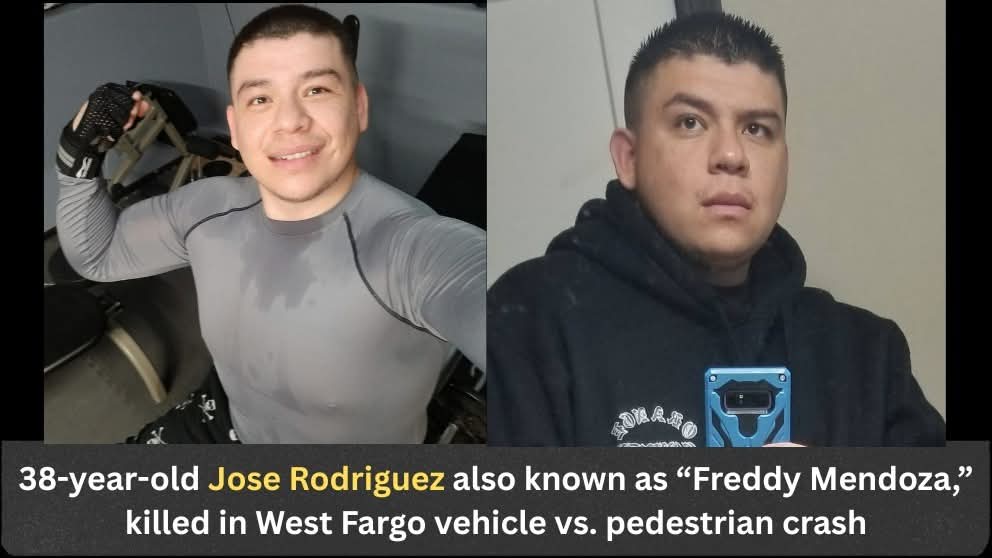
Jose Rodriguez (aka “Freddy Mendoza”) Killed in West Fargo Vehicle vs. Pedestrian Crash; Driver Carly Vizenor, 25, Left Scene Then Returned, Charges Pending
A Deadly Night on 32nd Avenue South
WEST FARGO, N.D. – In the pre-dawn darkness of a Wednesday morning, a stretch of 32nd Avenue South east of 9th Street became the site of a tragedy that has left a community grappling with grief, unanswered questions, and the unsettling behavior of a driver who initially fled. Jose Rodriguez, 38, of West Fargo — also known to friends and family as “Freddy Mendoza” — was struck and killed by a car in a vehicle‑vs.‑pedestrian crash. The driver, Carly Vizenor, 25, allegedly left the scene, only to return approximately ten minutes later. As of this writing, charges against Vizenor are under investigation by the North Dakota Highway Patrol.
The incident, which occurred at approximately 2:45 a.m. , has cast a harsh light on the dangers pedestrians face on suburban roads, the legal consequences of leaving an accident scene, and the profound loss of a man who lived two names but left one indelible mark on those who knew him.
The Crash: What We Know So Far
According to a news release from the North Dakota Highway Patrol, the deadly collision unfolded in the early morning hours on 32nd Avenue S. , a multi‑lane arterial road that serves as a major east‑west connector in West Fargo’s rapidly growing southern corridor. The area east of 9th Street is a mix of newer residential subdivisions, retail outlets, and undeveloped land, with speed limits typically ranging from 35 to 45 mph.
The Highway Patrol has confirmed the following sequence:
· Jose Rodriguez (aka Freddy Mendoza) was a pedestrian on or near the roadway.
· Carly Vizenor was driving a vehicle — the make, model, and color have not been publicly released — heading in an unknown direction along 32nd Avenue S.
· The vehicle struck Rodriguez. The force of the impact was fatal; Rodriguez died at the scene before emergency medical services could intervene.
· Instead of stopping immediately, Vizenor initially left the scene. This act, even if brief, constitutes a hit‑and‑run under North Dakota law.
· Approximately ten minutes later, Vizenor returned to the crash site. The highway patrol has not disclosed whether she returned voluntarily, after a call from a witness, or due to some other factor.
· Upon her return, she cooperated with investigators. The Highway Patrol has not announced an arrest, but charges against Vizenor are under investigation.
What remains unknown — and what investigators are likely piecing together through forensic evidence, witness statements, and surveillance footage — is why Rodriguez was on the roadway at 2:45 a.m., whether he was in a crosswalk or not, whether Vizenor was impaired or distracted, and why she left the scene in the first place.
The Victim: Jose Rodriguez, Also Known as “Freddy Mendoza”
For many who knew him, Jose Rodriguez was a warm presence in West Fargo’s Spanish‑speaking community. The fact that he was also known as “Freddy Mendoza” suggests a nickname or perhaps a second identity — something investigators will need to clarify, but which his friends have explained simply as a familiar moniker. “Everyone called him Freddy,” said a neighbor who asked to remain anonymous. “He was friendly, always helping someone out. He didn’t deserve to die like that, alone on the pavement at 3 in the morning.”
Rodriguez, 38, had been living in West Fargo for several years. The city, once a sleepy farm town, has exploded in population due to its proximity to Fargo and the oil‑related economic boom in western North Dakota. It now hosts a diverse workforce, including many immigrants and migrants who fill jobs in construction, hospitality, and logistics. Rodriguez was reportedly employed in the service industry, though specific employer details have not been released.
Friends describe him as a hard worker who enjoyed spending time with loved ones, listening to regional Mexican music, and attending small gatherings. “He had a big laugh,” said a coworker. “When Freddy walked into a room, you knew it. He was not a quiet guy. And now it’s just silence.”
His dual name — Jose Rodriguez / Freddy Mendoza — is not uncommon in Latino communities, where nicknames (apodos) often carry more weight than legal given names. “Freddy” could have been a childhood nickname, a middle name, or simply a name he preferred. The Highway Patrol included both in their official release to ensure that anyone searching for either name would find the correct information.
As of now, no formal obituary or memorial arrangements have been announced. His family has been notified, and they are said to be making arrangements to bring his remains to his country of origin or to hold services locally. The Mexican consulate in Fargo has reportedly been contacted to assist with family notifications.
The Driver: Carly Vizenor, 25, and the Question of Why She Left
Carly Vizenor, 25, of West Fargo (or possibly a nearby community — her exact residence has not been disclosed) now finds herself at the center of a criminal investigation. Her decision to leave the scene, even briefly, is legally significant. Under North Dakota Century Code § 39‑08‑02, the driver of any vehicle involved in an accident resulting in injury or death must immediately stop, remain at the scene, provide identification and insurance information, and render reasonable assistance to any injured person. Leaving before fulfilling these duties is a class B felony if the accident involves death, punishable by up to 10 years in prison and a $20,000 fine.
Vizenor’s return after ten minutes complicates the legal picture. Did she leave due to panic, then come to her senses? Was she attempting to avoid a DUI test until the alcohol or drugs had metabolized? Did someone convince her to go back? Or did she simply get lost or confused in the aftermath of a traumatic event? The Highway Patrol has not released statements from Vizenor, nor have they indicated whether she was under the influence of alcohol or drugs.
What is known is that upon her return, she did not flee again. She spoke with officers and presumably provided a statement. Toxicology results — standard in fatal crashes — are likely pending and can take several weeks. If impairment is found, Vizenor could face additional charges, such as vehicular homicide or manslaughter.
Vizenor’s driving record has not been made public, nor has any information about her employment, family background, or whether she has legal representation. The Highway Patrol’s statement that “charges against Vizenor are under investigation” is standard language used when an incident is still being reviewed by prosecutors. It is neither an admission of guilt nor a declaration of innocence.
The Scene: 2:45 a.m. on 32nd Avenue South
To understand the crash, one must understand the environment. 32nd Avenue South in West Fargo is a four‑lane thoroughfare with a painted center median, streetlights, and sidewalks on both sides for much of its length. However, the stretch east of 9th Street is darker, with fewer businesses and more undeveloped plots. At 2:45 a.m., traffic is light, but not nonexistent — shift workers, late‑night drivers, and delivery vehicles occasionally pass through.
Pedestrian activity at that hour is unusual but not unheard of. People walk home from a friend’s house, walk to a nearby convenience store, or simply take a late‑night stroll. Whether Rodriguez was walking with a destination in mind or was crossing the street when struck is unknown. The presence or absence of a crosswalk, the color of his clothing, and his sobriety are all factors that investigators will consider.
The Highway Patrol’s crash reconstruction team will measure skid marks (if Vizenor braked), check the vehicle’s event data recorder (the “black box”), and examine the damage pattern to determine speed and point of impact. Witnesses — if any — have likely already been interviewed. Surveillance footage from nearby gas stations, car dealerships, or homes with Ring cameras could provide critical evidence.
The Legal Process: What Happens Next?
The investigation is in its early stages, but the typical path forward includes several steps:
1. Completion of the crash investigation (1‑4 weeks): The Highway Patrol will finish reconstructing the accident, collect all evidence, and compile a report for the Cass County State’s Attorney.
2. Toxicology results (2‑6 weeks): Blood samples from Vizenor will be analyzed for alcohol and drugs. If results are positive and above legal limits (0.08% BAC for non‑commercial drivers), charges will be more severe.
3. Prosecutorial review (2‑8 weeks): The State’s Attorney will determine what charges, if any, to file. Possible charges range from failure to stop and render aid (a felony) to negligent homicide or even vehicular homicide if impairment is proven.
4. Arraignment and court proceedings: If charges are filed, Vizenor will be summoned to appear in East Central District Court in Fargo. Bail conditions may include surrendering her passport, no driving, and no contact with the victim’s family.
Civil litigation is also likely. Rodriguez’s family may file a wrongful death lawsuit against Vizenor and possibly her insurance company. North Dakota has a comparative fault system, meaning that if Rodriguez was partly at fault (e.g., jaywalking), any damages awarded could be reduced by his percentage of fault.
Hit‑and‑Run Trends: Leaving the Scene Is Alarmingly Common
The fact that Vizenor left the scene, even for ten minutes, sadly fits a national pattern. According to the AAA Foundation for Traffic Safety, a hit‑and‑run crash occurs every minute in the United States. In fatal pedestrian crashes, the driver flees in approximately one out of every five cases. Reasons range from panic and fear of legal consequences (especially for unlicensed or impaired drivers) to a lack of insurance or outstanding warrants.
North Dakota law is strict: leaving the scene of a fatal crash is a Class B felony with a mandatory minimum sentence of one year in prison if convicted. The fact that Vizenor returned may be considered a mitigating factor, but it does not erase the initial departure. Her lawyer might argue that she left due to shock or fear for her safety, then quickly corrected her mistake. Prosecutors might argue that ten minutes is a long time to think and that she only returned because she realized she would be caught.
Community Reaction: Mourning on Both Sides
The West Fargo community has reacted with a mix of grief and cautious judgment. On social media, friends of Rodriguez have posted tributes, sharing photos of him smiling, cooking at a backyard barbecue, or posing with a soccer ball. “Rest in peace, Freddy. You were too young,” wrote one Facebook user. “This is not how it was supposed to end.”
Others have focused on the driver. Some have expressed anger that Vizenor left at all. “She left him to die on the road. Cowardly,” read one comment. But a few have urged restraint: “Let the investigation finish. Panic makes people do stupid things. She came back. That says something.”
The West Fargo Police Department (which worked alongside the Highway Patrol) has not held a press conference, but a spokesperson said in a brief statement: “Our hearts go out to the family and friends of Mr. Rodriguez. We are committed to a thorough and transparent investigation.”
Pedestrian Safety in West Fargo: A Growing Concern
This fatal crash is not an isolated incident. West Fargo has experienced rapid growth — its population nearly doubled from 2010 to 2020 — and with more people and cars, pedestrian deaths have risen. In 2023 alone, North Dakota recorded 18 pedestrian fatalities, with three occurring in Cass County (which includes West Fargo and Fargo).
Advocates have called for safer crosswalks, better lighting on 32nd Avenue S., and reduced speed limits near residential areas. “We treat our roads like highways, but people live here,” said a local safe streets activist. “No one should lose their life just trying to get somewhere at night.”
The stretch where Rodriguez died — 32nd Avenue east of 9th Street — does not have a pedestrian crossing signal for several blocks. A person crossing mid‑block at 2:45 a.m. would be relying entirely on drivers’ alertness and their own judgment. One mistake from either party can be fatal.
The Human Cost: A Family’s Unthinkable Loss
While the legal process grinds forward, the family of Jose Rodriguez / Freddy Mendoza is living a nightmare. Relatives in West Fargo and possibly in Mexico are making funeral arrangements. They are also grappling with the why: Why was he out so late? Why didn’t the driver stop? Why did she leave? Why did he have to die?
In the days following the crash, a small memorial has appeared near the site — a bouquet of flowers, a candle, and a handwritten note in Spanish that reads, “Descansa en paz, amigo. Nunca te olvidaremos.” (Rest in peace, friend. We will never forget you.)
The Highway Patrol has asked anyone with information about the crash — especially any witnesses who saw the immediate aftermath or Vizenor’s vehicle before or after the collision — to contact them at their non‑emergency number. Even small details can help complete the picture.
Conclusion: Justice and Remembrance Hang in the Balance
The death of Jose Rodriguez (aka Freddy Mendoza) is a tragedy compounded by the confusion of a driver who left and then returned. As the investigation continues, the people of West Fargo await answers: Was alcohol involved? Was speed a factor? Why did Carly Vizenor drive away? And most importantly, will justice be served?
For now, all that is certain is that a 38‑year‑old man is gone — lost on a dark road in the early hours, far from home in a city that had become his home. He leaves behind a legacy of friendship, hard work, and a nickname that echoed through his community. And he leaves behind a family that will spend the rest of their lives wondering what might have been if that car had stopped, if that driver had stayed, if that night had gone differently.
The North Dakota Highway Patrol promises a full investigation. The Cass County State’s Attorney will decide on charges. A judge and perhaps a jury will have their say. But no courtroom decision can bring back Freddy Mendoza. That loss is permanent, and it is felt most deeply by those who knew the man behind the two names.
Leave a Reply