
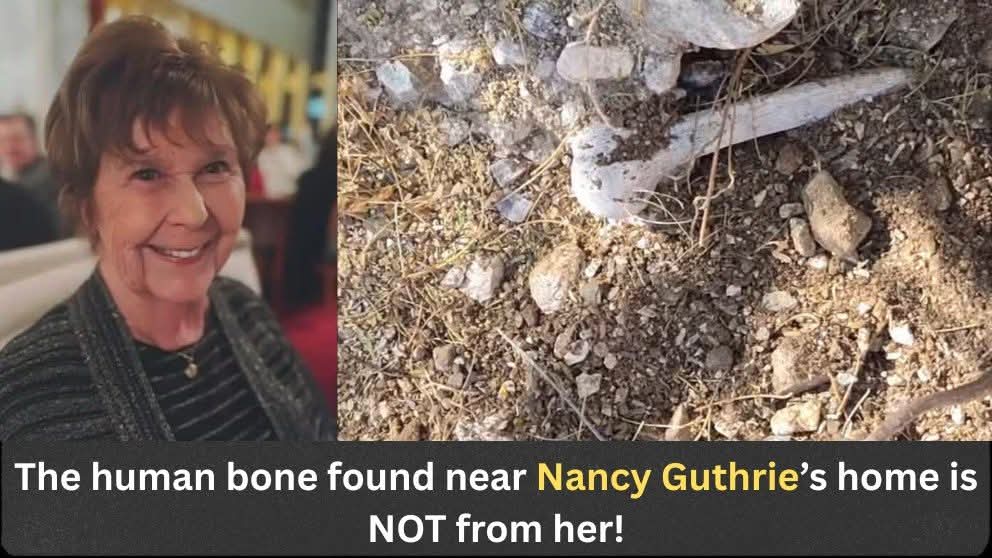
Human Bone Found Near Nancy Guthrie’s Home Not Connected to Her, Tucson Police Department Confirms; University of Arizona Anthropology Department Assists Analysis of Prehistoric Remains.
A Discovery That Sparked False Hope and Fear
TUCSON, Ariz. — The discovery of a human bone in the vicinity of a missing person’s home is always a moment of dread and anticipation. For those following the case of Nancy Guthrie, a woman who vanished under unclear circumstances, the recent recovery of a bone near her residence triggered a wave of speculation, grief, and — as it turns out — misinformation. Within hours, social media posts and online forums began circulating inaccurate claims that the bone belonged to Guthrie, suggesting that her remains had finally been found.
Those claims are false.
The Tucson Police Department (TPD) has issued a firm clarification: the human bone discovered near Nancy Guthrie’s home is not connected to her disappearance. In fact, investigators have determined that the bone is substantially older — at least 50 years old and possibly prehistoric — and is likely tied to the region’s rich Native American archaeological history. Experts from the University of Arizona Anthropology Department are now assisting in the examination, but authorities have urged the public to stop spreading unverified rumors.
As the search for Nancy Guthrie continues, this incident serves as a cautionary tale about the speed and danger of online misinformation, especially in emotionally charged missing persons cases.
The Discovery: A Bone in a Historically Rich Area
The exact location where the bone was found has not been disclosed by TPD to protect the integrity of the investigation and to discourage trespassing. However, authorities have confirmed that it was recovered near the home of Nancy Guthrie — a detail that naturally drew immediate attention. The home itself is situated in a part of Tucson known for its archaeological sensitivity. The region, including the greater Tucson basin, has been inhabited for thousands of years, first by the Hohokam people and later by the Tohono O’odham and other Indigenous groups.
Artifacts ranging from pottery shards to stone tools and even ancient burial sites have been unearthed throughout the area. According to the Tucson Police Department, the location where the bone was found is historically significant and has previously yielded numerous Native American artifacts. This history is precisely why investigators did not jump to conclusions.
Upon recovery, the bone was immediately treated as potential evidence. Officers secured the scene, documented the find, and transported the remains to the medical examiner’s office for preliminary analysis. That analysis quickly revealed something crucial: the bone did not match the expected characteristics of a recent death.
Preliminary Analysis: At Least 50 Years Old, Possibly Prehistoric
In a media statement, the Tucson Police Department explained that preliminary analysis indicates the bone is at least 50 years old and may even be prehistoric in origin. How can investigators tell? Forensic anthropologists and archaeologists use several indicators:
· Coloration and weathering: Bones exposed to the elements for decades or centuries take on distinct discoloration, cracking, and surface erosion. Fresh bone (less than a few decades old) appears different under microscopic examination.
· Soil staining and mineral absorption: Bones buried or lying on the surface for long periods absorb minerals from the surrounding soil, changing their density and chemical signature.
· Contextual evidence: The bone was found in a layer of soil or amid debris that contained other clearly ancient materials (e.g., lithic flakes, old charcoal, or non-modern trash).
While 50 years might sound relatively recent — the 1970s — it is important to note that the phrase “at least 50 years old” is a preliminary, conservative estimate. Further analysis could reveal the bone to be hundreds or even thousands of years old. The involvement of the University of Arizona Anthropology Department suggests that the bone may be archaeological rather than medico-legal.
The Role of the University of Arizona Anthropology Department
The University of Arizona is home to one of the nation’s most respected anthropology departments, with particular strengths in Southwestern archaeology, bioarchaeology, and forensic anthropology. The department operates a Human Identification Laboratory that regularly assists law enforcement with the analysis of unknown remains — both recent and ancient.
In this case, TPD has confirmed that experts from the University of Arizona Anthropology Department are assisting with the examination and investigation of the remains. Their tasks may include:
· Determining whether the bone is human or non-human (though police have already confirmed it is human).
· Estimating the age, sex, and ancestral background of the individual to whom the bone belonged — though with ancient remains, this is often more general.
· Assessing whether the bone was part of a formal burial (suggesting a sacred site) or if it was scattered by erosion, construction, or animal activity.
· Advising on cultural and legal obligations under the Native American Graves Protection and Repatriation Act (NAGPRA), if the remains are determined to be Native American.
The university’s involvement is standard practice in Arizona, where archaeological finds are common. In fact, Arizona state law requires that any discovery of human remains that are not clearly recent be reported to the county medical examiner, and if they are potentially ancient, to the State Historic Preservation Office and relevant tribal authorities.
Misinformation Spreads: The Danger of Unverified Claims
Despite the early and clear indications that the bone was not recent, social media platforms quickly became echo chambers of false information. Within 48 hours of the bone’s discovery, posts on Facebook, X (formerly Twitter), and Reddit claimed that Nancy Guthrie had been found — that the bone was “confirmed” to be hers, often citing anonymous sources or “police scanners.”
The Tucson Police Department took the unusual step of issuing a direct rebuttal, stating unequivocally: “Rumors claiming Nancy Guthrie had been found are false.” The department emphasized that no major developments have occurred in her case and that the bone is unrelated.
Why does misinformation spread so quickly in missing persons cases? Experts point to several factors:
1. Emotional investment: People desperately want closure for families. Any news, even if unverified, feels better than silence.
2. Algorithmic amplification: Social media algorithms prioritize engagement. A post shouting “NANCY GUTHRIE FOUND” gets clicks, shares, and comments, while a sober police statement is less exciting.
3. Erosion of trust in official channels: Some individuals believe law enforcement withholds information, so they turn to amateur detectives and online sleuths.
4. The “citizen journalist” phenomenon: People who listen to police scanners or have “inside sources” post what they think they know, often without context or verification.
The result is real harm. False reports cause emotional whiplash for Nancy’s family and friends — first the hope of resolution, then the crushing disappointment of misinformation. They also waste investigative resources, as police must divert time to debunking rumors rather than pursuing genuine leads.
Who Is Nancy Guthrie? A Disappearance That Remains Unsolved
For readers unfamiliar with the case, Nancy Guthrie is a Tucson woman whose disappearance has been the subject of ongoing investigation. While the original news article does not provide details about when she went missing or the circumstances, public records indicate that Guthrie’s case has drawn significant attention due to its mysterious nature. (Note: As this is an expansion of a specific news brief, we rely on the context provided: she is missing, and her case remains active.)
What is known from the Tucson Police Department’s prior statements (from other reports) is that Nancy Guthrie was last seen at her home in Tucson. Her disappearance is considered suspicious, and law enforcement has followed multiple leads over time. No arrest has been made, and her whereabouts remain unknown.
The discovery of any human remains near her home — even if quickly ruled out — inevitably raises questions and anxieties. Could her remains be elsewhere in the area? Could the case be connected to another crime? The police have not commented on any links, and investigators continue to treat her case as a standalone missing persons investigation.
Archaeological Context: Why Ancient Bones Are Common in Tucson
For those unfamiliar with Arizona’s prehistory, the idea of finding a centuries-old human bone “near someone’s home” might seem bizarre. But in Tucson, such discoveries are not uncommon. The Sonoran Desert has been continuously inhabited for over 12,000 years. The Hohokam culture, known for its extensive canal systems, thrived in the Tucson area from approximately 500 CE to 1450 CE. Later, the O’odham peoples lived in the region before and after European contact.
When modern development occurs — whether for housing, roads, or utilities — archaeological surveys are required. However, erosion, animal burrowing, and even landscaping can bring ancient remains to the surface without any construction. A heavy rain can wash out a hillside, exposing burial pits or scattered bones that have been underground for centuries.
The Tucson Police Department’s reference to “numerous Native American artifacts and archaeological discoveries” in the area is entirely plausible. In some Tucson neighborhoods, it is not unusual for residents to find pottery shards in their gardens. The difference is that a human bone triggers a law enforcement response, whereas a pot shard might simply be reported to the Arizona State Museum.
Legal and Cultural Protocols: Respecting Ancient Remains
When human remains are discovered in Arizona and determined to be ancient (generally defined as over 50 years old and of archaeological interest), law enforcement steps back and a different process begins. The medical examiner determines that no forensic investigation is needed (i.e., the death is not recent and not suspicious in a modern criminal sense). Then the State Historic Preservation Office (SHPO) is notified, along with the Arizona State Museum and potentially the Tohono O’odham Nation, the Pascua Yaqui Tribe, or other federally recognized tribes with cultural ties to the area.
Under the Native American Graves Protection and Repatriation Act (NAGPRA) , any Native American human remains and associated funerary objects must be repatriated to the appropriate tribal nation for reburial or other culturally appropriate disposition. This process is handled with great care and respect, often away from the public eye to protect sacred sites.
In this case, because the bone was found near a residence, it is unlikely to be an intact burial. More likely, it is an isolated bone that was disturbed by animals, erosion, or prior landscaping. Even so, the protocol will be followed.
The Public’s Role: How to Avoid Spreading Misinformation
The Tucson Police Department’s clarification is not just a statement — it is a plea. In missing persons cases, especially high-profile ones, the public can be either a help or a hindrance. Responsible citizens can:
· Verify before sharing: Check the source. Is the information coming from a verified law enforcement account or a reputable news outlet? If not, wait.
· Report suspicious posts: If you see someone claiming a false “confirmation” of a missing person’s death, report the post to the platform.
· Share official updates: Amplify the voices of the police department, the FBI, or the family’s official spokesperson — not anonymous online sleuths.
· Respect the family’s grief: Imagine being Nancy Guthrie’s loved one and seeing a false report that her remains were found. That pain is real.
Ongoing Search for Nancy Guthrie: No New Developments
Importantly, the clarification about the ancient bone does not mean the investigation into Nancy Guthrie’s disappearance has stalled or progressed. According to the Tucson Police Department, no major developments have been announced in her case. It remains active and ongoing. Detectives continue to follow leads, interview persons of interest, and seek any new information from the public.
The department has not disclosed whether the area near her home continues to be searched or whether the recent bone discovery prompted a wider search of the vicinity. Given that the bone was quickly ruled out, any search related to it has likely concluded. However, law enforcement typically does not comment on tactical decisions.
Conclusion: A Bone from Another Time, A Case Still Open
The discovery of a human bone is always unsettling. But in this instance, what could have been a tragic resolution to the Nancy Guthrie case turned out to be a glimpse into Tucson’s ancient past. The bone — at least 50 years old, possibly prehistoric — is a reminder that the land beneath our feet holds stories from long before modern missing persons cases.
For Nancy Guthrie’s family and friends, the false rumors added an unnecessary layer of pain. For the community, the incident highlights the importance of relying on official sources. And for the University of Arizona Anthropology Department, it is another opportunity to apply science to the service of both history and justice.
The Tucson Police Department continues to ask anyone with information about Nancy Guthrie’s disappearance to come forward — not with speculation about ancient bones, but with facts. Until then, her case remains unsolved, and the search for truth goes on.
Leave a Reply