
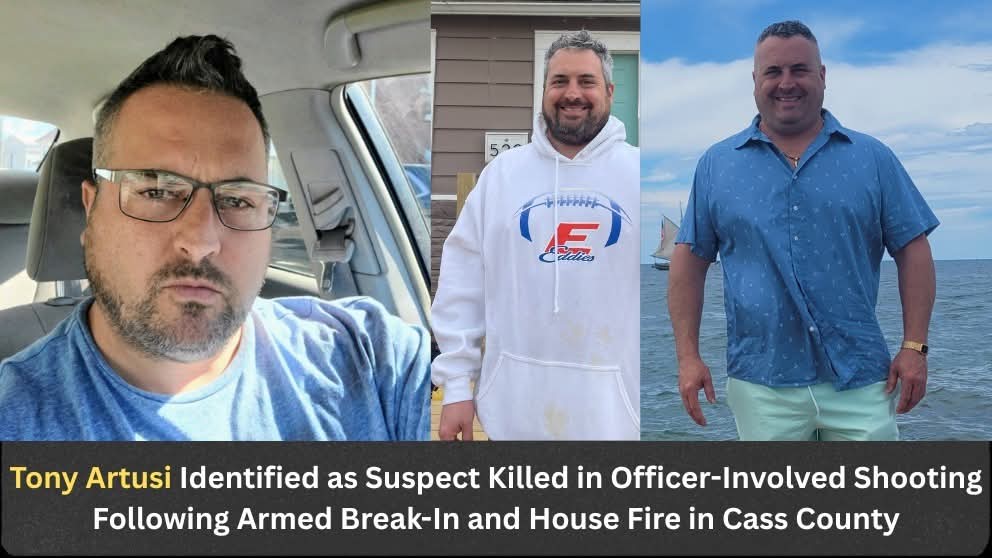
Tony Artusi Killed in Officer-Involved Shooting After Armed Break-In and House Fire in Cass County; Michigan State Police Investigate Jefferson Township Incident.
CASS COUNTY, Mich. — What began as a quiet Wednesday afternoon in rural Jefferson Township rapidly spiraled into a cascade of violence, fire, and police gunfire. Authorities have identified the man killed in an officer-involved shooting as Tony Artusi, a 46-year-old resident of nearby Edwardsburg. His death marks the latest in a series of complex, multi-layered incidents where law enforcement and civilian lives collide under extreme duress.
According to official statements released by the Cass County Sheriff’s Office and confirmed by Michigan State Police, the deadly sequence started with a report of an armed home invasion, quickly added a structure fire, and ended with an exchange of gunfire between Artusi and responding officers near a set of railroad tracks and later at a street intersection. By the time the smoke cleared — both literally and figuratively — Artusi lay unresponsive, later pronounced dead, and a residential fire continued to smolder as investigators began the painstaking work of reconstructing the final minutes of his life.
The Initial Report: Armed Man Kicks in Door on Davis Lake Street
The incident unfolded shortly after 12:00 p.m. on a Wednesday that residents of the 29000 block of Davis Lake Street in Jefferson Township will not soon forget. Deputies from the Cass County Sheriff’s Office were dispatched to the address following frantic 911 calls reporting an armed man who had allegedly kicked in the front door of a home.
Jefferson Township is a predominantly rural area characterized by scattered single-family homes, farmland, and wooded lots. It is not the kind of place where violent home invasions or officer-involved shootings are commonplace. Neighbors often know each other by sight, and the sound of sirens is rare. That is why the events of that afternoon sent a shockwave through the community.
When deputies first arrived on scene, they did not immediately encounter the suspect. Instead, they found the 911 callers — residents of the home — who had managed to escape the residence by running out the back door. These witnesses, whose names have not been released by authorities, told deputies that they fled specifically to avoid the armed intruder. Their quick thinking likely saved their own lives, but it also meant that when police arrived, the suspect was no longer inside the burning structure.
Because as deputies spoke with the shaken residents, they noticed something alarming: the home had caught fire. It remains unclear whether the fire was intentionally set by Artusi during the break-in or ignited accidentally as a result of the confrontation or some other cause. What is clear is that emergency crews were immediately called to respond, and what had begun as a law enforcement matter now also became a firefighting emergency.
The Escalation: A Large Active Investigation Takes Shape
With a home on fire, an armed suspect at large, and multiple agencies now involved, the situation quickly escalated into what officials described as “a large active investigation.” Mutual aid agreements were triggered, and additional officers from nearby jurisdictions began converging on Jefferson Township.
The early moments of any officer-involved incident are chaotic by nature. Law enforcement must simultaneously secure the perimeter, locate the suspect, assist victims, and coordinate with fire and EMS. In this case, deputies had additional challenges: they did not know if the suspect was still armed, whether he had accomplices, or what his mental state might be. All they knew was that a man had forcibly entered a home with a weapon, the home was on fire, and the suspect had fled.
Witnesses in the area later told local media that they saw deputies canvassing the neighborhood, speaking to residents, and requesting that people stay inside their homes. A shelter-in-place advisory was unofficially circulated through social media and neighborhood text chains. Parents kept children indoors. Dogs were brought inside. And all eyes turned toward the horizon, looking for any sign of the armed man.
The First Police Encounter: Gunfire Near the Railroad Tracks
Investigators later located Tony Artusi near railroad tracks close to Harris Street, a thoroughfare that runs through a more industrial and less densely populated section of the township. It was there, according to law enforcement statements, that the first exchange of gunfire occurred.
Officials have been notably cautious in their public remarks about who fired first. In a press release, police confirmed only that “gunfire was exchanged in the area around that time” near the tracks. No officers were reported injured in this initial exchange, and it remains unknown whether Artusi was struck during this confrontation or whether he managed to flee again.
What is clear is that the encounter near the railroad tracks did not end the threat. Artusi — still armed, still mobile, and now having exchanged gunfire with law enforcement — continued to move through the neighborhood. For a brief window of time, he was a moving target in a rural landscape, dangerous and unpredictable.
Police later confirmed that after the railroad tracks incident, officers received another report placing Artusi near the intersection of Pine Lake Street and Harris Street. That location is only a short distance from the original home invasion scene, meaning Artusi had not fled far. He was circling back, perhaps trying to escape on foot, perhaps looking for a vehicle, or perhaps — as some criminal behavior experts speculate — moving with no clear plan other than survival and resistance.
The Final Confrontation: Exchange of Gunfire at Pine Lake and Harris
According to the official timeline, it was at the intersection of Pine Lake Street and Harris Street that the encounter between Tony Artusi and law enforcement turned fatal. Police said that this second confrontation also led to an exchange of gunfire between officers and the suspect.
The exact number of rounds fired, the number of officers involved, and the precise sequence of events remain under investigation. However, following this exchange, Artusi was found unresponsive on or near the roadway.
First responders — including emergency medical personnel who had already been staged in the area due to the house fire — immediately rendered medical aid to Artusi. They administered CPR, controlled any bleeding, and attempted to stabilize him for transport. Despite their efforts, officials later confirmed that Artusi died from his injuries at the scene.
No law enforcement officers were reported injured during either exchange of gunfire, although standard protocol requires that all involved officers undergo medical and psychological evaluation following any use of deadly force.
The Aftermath: Michigan State Police Take Over Investigation
In the immediate wake of the shooting, the scene was secured with yellow tape and patrol vehicles. The intersection of Pine Lake and Harris was closed for hours as evidence technicians documented shell casings, measured distances, and photographed blood evidence. The burned home on Davis Lake Street remained an active fire scene and later a separate crime scene, with investigators searching for accelerants, signs of forced entry, and any connection between Artusi and the residents.
Per Michigan law and standard protocol for officer-involved shootings, the investigation was handed over to an outside agency to ensure transparency and avoid any conflict of interest. The Michigan State Police 6th District Investigative Response Team (IRT) has taken over the full investigation into the shooting. The IRT is a specialized unit trained to handle critical incidents involving police use of deadly force, including officer-involved shootings, in-custody deaths, and other major events.
Officials have confirmed that all officers involved in the shooting are being investigated as part of the ongoing review. This is not an indication of wrongdoing but rather a standard procedural step. The investigation will examine body camera footage (if any officers were equipped), dash camera recordings, witness statements, physical evidence from the scene, and the criminal history and mental state of Tony Artusi.
Who Was Tony Artusi? A Complex Portrait Emerges
As investigators piece together the final hours of Tony Artusi, neighbors and acquaintances have begun to offer fragments of a more complicated picture. Artusi, 46, lived in Edwardsburg, a small village approximately 10 miles from the Jefferson Township incident site. Edwardsburg is a tight-knit community with a population of just over 1,200 people, where most residents know each other by reputation if not by name.
Public records indicate that Artusi had lived in the area for several years. Neighbors described him as a quiet presence, someone who kept to himself but was not considered dangerous or erratic. “He would wave when you drove by, but he didn’t come to block parties or anything like that,” one neighbor told a local news outlet, speaking on condition of anonymity. “I’m shocked. You never think something like this would happen with someone you see at the mailbox.”
However, law enforcement sources (speaking unofficially) noted that Artusi had a prior criminal record, though specific charges and convictions were not immediately disclosed. The ongoing investigation will likely explore whether Artusi was under the influence of drugs or alcohol, whether he was suffering from a mental health crisis, or whether the home invasion was targeted or random.
The fact that Artusi allegedly kicked in the front door of a home where residents were present suggests either extreme desperation, severe mental disturbance, or a specific grievance against the occupants. Investigators have not yet released any connection between Artusi and the residents of the Davis Lake Street home. It remains possible that the home was chosen at random or that Artusi was looking for someone or something specific.
The House Fire: A Pivotal and Unanswered Question
One of the most puzzling elements of this case is the fire. When deputies arrived, the home was already burning. The residents had escaped through the back door, meaning the fire started while they were still inside or immediately after they fled. But how?
Several theories are under consideration:
· Intentional arson by Artusi: If Artusi entered the home with a weapon and then deliberately set a fire, that would elevate the crime from burglary to arson and potentially attempted murder. Accelerant-sniffing dogs and fire investigators will examine the scene for signs of gasoline, lighter fluid, or other ignitable liquids.
· Accidental fire during the break-in: Artusi could have knocked over a candle, damaged a gas line, or shorted an electrical appliance while forcing entry or moving through the home. In such a scenario, the fire would be a tragic byproduct rather than an intentional act.
· Fire unrelated to the break-in: It is also theoretically possible that the fire started independently — for example, from faulty wiring or a kitchen accident — and that Artusi’s invasion was coincidental or opportunistic. However, the timing (fire discovered immediately after the break-in) makes this less likely.
The Michigan State Police fire investigation division is working alongside the IRT to determine the origin and cause of the blaze. Their findings could be crucial in establishing Artusi’s intent and criminal liability, which in turn could inform why officers felt justified in using deadly force.
Legal and Procedural Context: Police Use of Deadly Force in Michigan
Under Michigan law, law enforcement officers are authorized to use deadly force when they reasonably believe that a suspect poses an imminent threat of death or serious bodily harm to the officer or others. The key legal standard is “reasonableness” — an objective test based on what a similarly trained officer would have done under the same circumstances.
In this case, officers had already engaged in one exchange of gunfire with Artusi near the railroad tracks. By the time they encountered him again at Pine Lake and Harris, they knew he was armed, had already shot at them (or at least exchanged fire), and was refusing to surrender. In such a scenario, courts have generally found that officers are justified in using deadly force to stop a fleeing felon who poses a continuing threat.
However, the investigation will examine whether officers attempted de-escalation, whether commands to drop the weapon were given, and whether Artusi was turning toward or away from officers when shots were fired. Body camera footage, if available, will be the most critical evidence. If no body cameras were worn — a possibility in smaller jurisdictions with limited budgets — the investigation will rely more heavily on witness accounts and forensic evidence.
The Michigan State Police IRT is expected to complete its investigation within several weeks, after which the findings will be submitted to the Cass County Prosecutor’s Office. The prosecutor will determine whether the use of deadly force was legally justified or whether any officers should face criminal charges. In the vast majority of officer-involved shootings in Michigan, prosecutors rule the force justified.
Community Reaction: Grief, Shock, and Demands for Transparency
In the days following the shooting, residents of Cass County have expressed a range of emotions. Some have left flowers and notes near the intersection of Pine Lake and Harris — a makeshift memorial for Tony Artusi, despite his alleged role as an armed intruder. “He was still someone’s son, someone’s friend,” read one unsigned note. Others have voiced support for the deputies, arguing that they had no choice but to fire after Artusi exchanged gunfire with them.
Local churches have opened their doors for community discussions and prayer vigils. The Cass County Sheriff’s Office has issued brief statements but has not held a full press conference, citing the ongoing investigation. The Michigan State Police have been more forthcoming, releasing a limited summary of events while cautioning that details may change as evidence is analyzed.
The home on Davis Lake Street remains cordoned off, its blackened exterior a stark reminder of the chaos that erupted on an otherwise ordinary Wednesday. The residents who fled out the back door have been relocated by the American Red Cross and are cooperating with investigators. They have not spoken publicly, likely on the advice of legal counsel.
Ongoing Investigation: What Comes Next
The investigation into the officer-involved shooting, the armed break-in, and the house fire is far from complete. Authorities have confirmed that:
· All three incidents remain under active investigation as part of a unified inquiry led by the Michigan State Police 6th District IRT.
· Evidence continues to be gathered, including firearm ballistics, fingerprints, DNA, and any digital evidence from cell phones or home security cameras in the area.
· Witness interviews are ongoing. Police have asked anyone with information about Artusi’s whereabouts or behavior in the hours before the incident to come forward.
· Autopsy results will be released by the medical examiner’s office, including toxicology screening that could reveal the presence of drugs or alcohol in Artusi’s system.
· The number of officers involved and their identities have not been released, though they have been placed on administrative leave pending the investigation — again, a standard practice.
The Cass County Sheriff’s Office has promised a full public accounting once the investigation is complete, consistent with Michigan’s commitment to transparency in critical incidents. However, they have also asked for patience, noting that thorough investigations take time.
A Final Reflection: Violence in the Rural Midwest
The death of Tony Artusi is a tragedy on multiple levels. For his family and friends — none of whom were named in the initial police report but who are undoubtedly grieving — it is a personal loss marked by confusion, anger, and sorrow. For the residents of the home he allegedly invaded, it is a trauma that will linger, compounded by the loss of their home to fire. For the officers who fired their weapons, it is an event that will be scrutinized, second-guessed, and carried for the rest of their careers.
And for the people of Cass County, it is a jarring reminder that violence does not confine itself to big cities. It can arrive on a quiet street, at noon, in the form of a man kicking in a door, setting a fire, and exchanging gunfire with police near a set of railroad tracks.
As the investigation continues — and as the community waits for answers — one thing is already clear: the events of that Wednesday afternoon have left scars that will not quickly heal. The only certainty is that more information will emerge, and when it does, it will reshape the story once again.
Leave a Reply